Hariharan Senthilkumar - Week 12: The Dangers of Book Bans
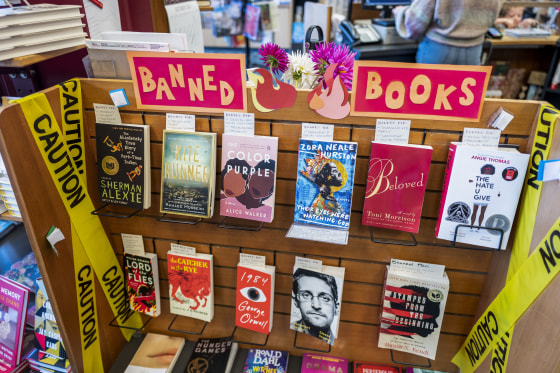
Image Credit: https://www.nbcnews.com/nbc-out/out-news/1600-books-banned-2021-22-school-year-report-finds-rcna48367
Books have power, and in recent years, people have begun to realize just how much power literature holds; this has manifested in book bans spreading across the nation. There are many reasons why people support book bans, but the one common theme between these justifications is that people don't believe these books are appropriate for children. Certainly, there is an element of truth: not all literature is meant to be consumed by the youth. However, what book banners define as "inappropriate" is wildly different from person to person.
Books from many Black authors such as The Hate U Give by Angie Thomas, I Know Why the Caged Bird Sings by Maya Angelou, Beloved by Toni Morrison, and many others have been banned. Many books that contain themes of race and racism have been banned on grounds of "inciting violence" or displaying "anti-police attitudes." Many banners say that books like this cause children to feel bad or guilty about the nation's sins.
Books that discuss political upheaval or standing up to tyranny have also (ironically) been banned in many schools and districts across the nation. For example, 1984 by George Orwell, The Hunger Games by Suzanne Collins, and many others. Books like this have been banned based on "violence," "inciting rebellion," and being "anti-family."
Books that discuss feminism or the struggle of women in society have also been banned. For example, The Handmaid's Tale by Margaret Atwood, The House on Mango Street by Sandra Cisneros, and The Bluest Eye by Toni Morrison. Books like this have been banned based on "sexual content", "controversial issues", and "assault."
Books that discuss queerness or the experience of non-heterosexual people have been perhaps the most heavily silenced. In states like Florida, the very mention of the word "gay" is grounds for banning. Banned books in this category include, All Boys Aren't Blue by George M. Johnson, Cinderella is Dead by Kalynn Bayron, and The Drowning of Stephan Jones by Bette Greene. Books like this have been banned based almost exclusively on "sexual content" and "anti-Christian" messages.
To some extent, I understand. Some of these books are too heavy for children to truly process, but that is no reason for the books to be banned from schools and public libraries. Children and students are not the same thing, after all. Books like this should still be taught during a student's junior and senior years of high school when they can process the book's contents. These books should still be accessible in schools even if they are not taught.
An important thing to note is that, for some of these books, the reasons for the ban are blown out of proportion. This is seen clearly when a Tennessee school district banned Maus by Art Spiegelman. The ban on Maus was because of the "nudity" of the Jewish characters in Aushwtitz. Spiegelman, after reading the meeting minutes, said that he had the feeling that the district members were not really concerned about the nudity, but more about making a more palatable version of the Holocaust.
Humanity is bloody. It is violent, it is cruel, it is heartbreaking, it is painful, it is horrible. Millions have been killed, assaulted, tortured, humiliated, and forced to undergo every possible pain. Our own nation was built on the backs of slaves who were degraded, humiliated, and treated like trash. Reframing our history and banning people's stories because it doesn't fit our narrative of a happy, sunshiny America is not going to help the nation in any way.
Books have the power to show people just how horrible the past was and the unforgivable atrocities that humans everywhere have committed. Many of these books do not shy away from the gruesomeness and the horror of human actions. But, in my opinion, this is a good thing. For every person who reads books like these and gains awareness of our shared history, one less person is in danger of repeating our past mistakes. Ignorance has never helped anybody, but awareness and forward-thinking will.


Hi Hari! I think your blog touched on such an pertinent, under talked about topic. Books are the most widespread form of expression. To limit the access of books is to limit freedom of speech. To recreate history to fit in the cookie-cutter cultural norms spreads a false narrative to the youth and creates a misconceptions about reality. I especially appreciated your paragraph at the end where you established the importance of making media in the form of book accessible. History is something that is unchangeable, and it serves a higher importance to teach it the way it is rather than to sugarcoat it. Thank you for sharing!
ReplyDeleteYour blog was amazingly written and I really like the topic you chose as it is not only important to contemporary issues but also generally interesting. I think the novelty of books lies in the fact that books can teach us about perspectives we couldn't even begin to conceive by ourselves. Books show us the lives of people across the world, across time, and across any societal barriers. They teach us empathy through, like you said, facilitating awareness and diminished ignorance. I also noticed that you used one of the argument writing techniques of pointing out a limitation in your argument and refuting, which was a great idea! Your blog is really well written and I always enjoy reading your writing. I hope to read more like this in the future!
ReplyDeleteHi Hari!
ReplyDeleteFirst off, I was immediately engaged by your blog from the first quote and I was nothing short of excited for the rest of the blog because of this captivating start and I think it's safe to say that I was not disappointed. From structure, to content, to its overall message, your blog was amazingly written and incredibly informative. I also wanted to say how I impressed I am that you are able to include so much knowledge of a wide array of topics in each of your blog posts as none of them are the same as the last. But more specifically, focusing on how book bans have been put in place partially to filter hardships and struggles of individuals or groups in the past and how this is wrong is an important topic to talk about which I think you covered perfectly in this post. Also, in your concluding paragraph, your re-assertion of your own opinions with the obvious support of your previous words was amazing. Overall, I truly enjoyed reading your blog this week and I look forward to reading your next blog!